
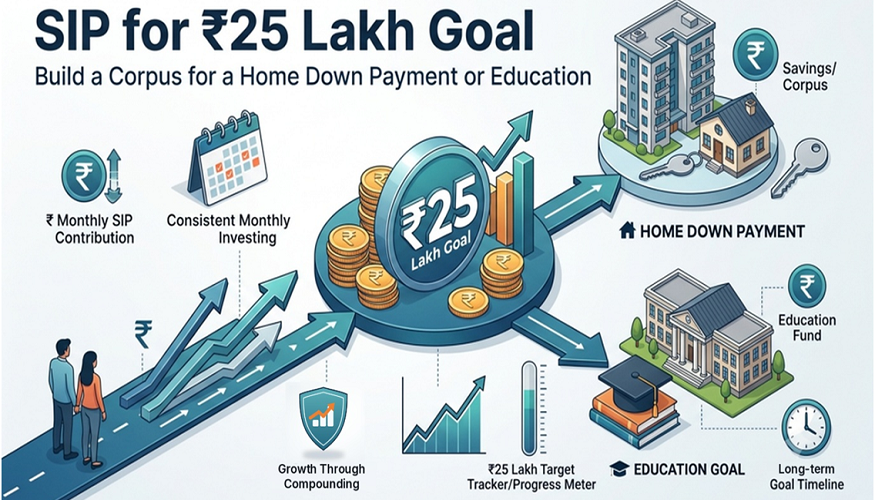
A ₹25 lakh corpus can be a practical financial milestone for many investors. It may help fund a home down payment, children’s higher education, a business requirement or another significant life goal. Unlike an open-ended wealth-creation objective, a ₹25 lakh goal usually has a defined purpose and timeline. This makes goal-based planning particularly important.
A systematic investment plan (SIP) can help convert the target into manageable monthly investments. However, the right SIP for 25 lakh depends on when you need the money, how much you have already accumulated and the level of investment risk you can reasonably take.
Start With the Purpose of the ₹25 Lakh Goal
The same ₹25 lakh can mean very different things depending on its purpose.If it is intended as a home down payment, you may need to co-ordinate the investment goal with property prices, registration costs and the future home-loan EMI.If the goal is children’s education, education inflation becomes an important consideration. A course costing ₹25 lakh today could cost considerably more when the child reaches college age.
Therefore, before calculating your SIP, identify what the ₹25 lakh is meant to achieve and when you will need it.
Calculate the Monthly SIP
The investment period has a major impact on the monthly amount required. A sip calculator can help estimate the monthly investment needed based on the ₹25 lakh target, investment period and assumed annualised return.
For illustration, assuming an annualised return of 10%:
- 5 years: approximately ₹32,300 per month
- 7 years: approximately ₹20,800 per month
- 10 years: approximately ₹12,200 per month
- 12 years: approximately ₹8,900 per month
These figures are illustrative calculations, not assured returns. Mutual fund investments are market-linked and actual returns may vary. A longer horizon generally reduces the monthly contribution required to reach the same nominal target, although delaying the goal may not always be practical.
For a Home Down Payment, Factor in the Full Cost
If the ₹25 lakh is intended for a house purchase, avoid treating the entire amount as the down payment automatically.A home purchase can involve registration and stamp-duty charges, brokerage, documentation, interiors and other expenses. Keeping a separate emergency reserve is also important.
For example, if you intend to use ₹20 lakh as the down payment, the remaining ₹5 lakh may need to cover some purchase-related expenses or remain as part of your financial buffer, depending on the circumstances.
You should also estimate whether the eventual home-loan EMI will fit comfortably into your monthly budget.
For Education, Account for Education Inflation
Education is another goal where today’s cost may not represent the future requirement.
Suppose higher education currently costs ₹25 lakh and you expect to need the money 10 years from now. At an assumed education inflation rate of 8%, the future requirement would be approximately ₹54 lakh.This is only an illustration. Education costs vary considerably by institution, course, country and other factors.
Consequently, someone planning an education goal should not automatically set their target at ₹25 lakh simply because that is the current estimated cost. The target should reflect the expected future expense.
Income often increases over time, making a fixed SIP less relevant after several years.
Consider a Step-Up SIP (SIP Top-Up)
A step-up SIP allows the monthly contribution to increase periodically. For example, you could start with a manageable amount and increase it by 5 to 10% annually as your income grows.This can be particularly useful for a ₹25 lakh goal because the initial monthly commitment may otherwise appear high for someone early in their career.
However, the step-up should remain realistic and should not compromise emergency savings, insurance premiums or other essential financial commitments.
Align the Investment With the Goal Date
The investment strategy should reflect the time remaining.For a long-term education goal, an investor may have more time to tolerate market volatility, depending on their risk profile. A shorter-term home down-payment goal requires greater attention to capital preservation and liquidity as the purchase date approaches.
As the goal gets closer, periodically reviewing the portfolio can help reduce the risk of a significant market decline immediately before the money is required.
₹25 Lakh Is a Goal, Not Just a Number
The usefulness of an SIP for 25 lakh lies in connecting a large financial requirement to a specific life objective.
The planning process can be summarised as:
Identify the goal → estimate the future cost → determine the timeline → calculate the SIP → increase contributions as income grows → review the portfolio periodically.
Whether you are building a home down payment or preparing for your child’s education, the objective should be to create a corpus that matches the actual future requirement.A disciplined SIP can make the journey more structured, but the target itself should be reviewed as property prices, education costs, inflation, income and your financial circumstances change.
Disclaimer: This article is for educational purposes only and should not be considered investment advice. Mutual fund investments are subject to market risks, and returns are not guaranteed. All return and inflation assumptions used above are illustrative. Actual investment outcomes and future costs may differ.
One thought on “SIP for Rs25 Lakh Goal: Build a Corpus for a Home Down Payment or Education”